Dogs
The tamed wolf that reinvented the history of humanity
Approximately 15,000 years ago, somewhere between central Eurasia and Southeast Asia, an unprecedented evolutionary process transformed the gray wolf (Canis lupus) into a fundamentally different animal: the domestic dog (Canis lupus familiaris).
Read more (431 mots)Show less▾
This domestication was not the result of deliberate human decision, but rather the outcome of progressive co-evolution, where wolves with the least aggressive temperaments gravitated toward human settlements, benefiting from food scraps while offering increased vigilance and hunting assistance in return.
This millennia-long relationship shaped not only the dog's behavior but also its biology. The dog possesses multiple copies of the amylase gene (AMY2B), allowing it to digest starch far more efficiently than wolves—a direct adaptation to grain-based human diets. Its brain has also evolved to decode human facial expressions with remarkable precision: studies published in Science have shown that dogs follow human gaze in a way that even chimpanzees do not.
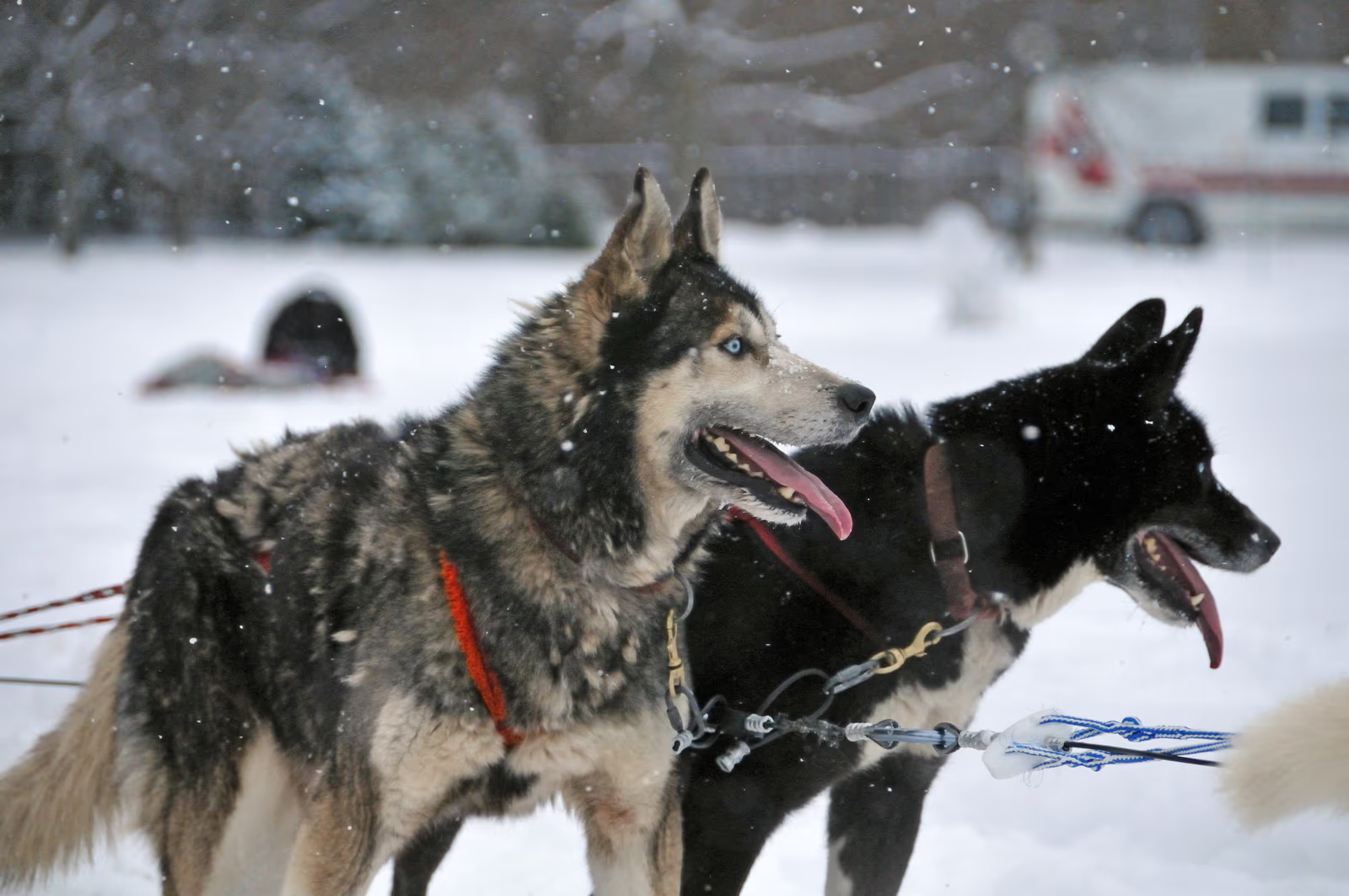
Today, the dog embodies the greatest morphological diversity of any animal species. With over 340 breeds recognized by the International Cynological Federation (FCI), distributed across 10 functional groups, we encounter everything from the Chihuahua (1–3 kg) to the Saint Bernard (70–90 kg), from the slender Greyhound built for speed to the compact Bulldog shaped by extreme selection. This diversity reflects centuries of selective human breeding aimed at specific functions: herding, hunting, protection, sledding, and companionship.
Behaviorally, the dog remains an intensely social animal, whose ancestral pack organization translates today into a profound need for belonging to a human group. It interprets social hierarchies, responds to vocal tones, memorizes hundreds of words, and anticipates routines with a precision that continues to surprise ethologists. Breeds like the Border Collie have demonstrated the ability to memorize over 1,000 named objects, thus rivaling non-human primates in terms of social cognition.
Longevity varies considerably according to size: small breeds (Poodle, Yorkshire Terrier) frequently live 14–17 years, while giants (Great Dane, Leonberger) rarely exceed 8–10 years. This inverse correlation between size and life expectancy remains a biological phenomenon still partially unexplained, linked to faster cellular growth rates in larger dogs.
Overview
0.1–100 kg
Weight range
min ↔ max documented
7–17 ans
Life expectancy
all ages
Medium
Majority size
348 breeds of 486
7
Hypoallergenic
of 486 listed
Distribution by size
Ideal profile
What should good food contain for dog ?
Nutritional ranges validated by our team. These are the ranges our PawScore considers ideal.
Dog dry food
- Protein22–35%
- Fat12–20%
- Fiber2–5%
- Calories320–400kcal
Dog wet food
- Protein7–12%
- Fat3–8%
- Fiber0.3–2%
- Calories75–120kcal
Dog BARF
- Protein12–20%
- Fat8–15%
- Fiber1–3%
- Calories120–180kcal
Values outside the range are not dangerous, but slightly reduce the PawScore according to our methodology.
By build
Choose by size
The #1 criterion when choosing a breed — space needed, transport, budget.
Discover
The essentials
A selection to start your exploration of dogs.


Lifestyle
Daily Activity
Read more (434 mots)Show less▾
Dogs' exercise needs vary considerably depending on breed, age, and health status, but one principle applies across all categories: no dog is satisfied with a sedentary lifestyle. An adult Golden Retriever requires 1.5 to 2 hours of active daily walking, spread across multiple outings. A Border Collie or Malinois, bred for endurance and liveliness, needs 2 to 3 hours of intense activity, including cognitive stimulation exercises (obedience, tracking, agility). Conversely, a Basset Hound or French Bulldog tolerates about one hour daily, provided outings respect their morphology (overheating risk for brachycephalic breeds).
Mental stimulation is as essential as physical exercise. A dog whose intellect is not engaged develops compulsive behaviors: destruction, repetitive barking, self-injury. Search games (nose work), food puzzles, and learning new commands maintain behavioral balance far beyond simple physical exertion.
Indoor Living
Dogs adapt to a wide range of living configurations, from a Parisian studio to a property with a garden, provided their fundamental needs are met. In an apartment, the frequency of outings takes priority over living space: three to four daily outings, including at least one lasting over 30 minutes, effectively compensate for the lack of a yard for most medium-sized breeds. Indoor space should include a designated rest area, sheltered from air currents and high-traffic zones.
Tolerance for solitude is a skill acquired gradually, ideally from a young age through progressive desensitization. A dog left alone regularly for more than 6 to 8 hours faces high risks of separation anxiety, a common condition sometimes requiring behavioral follow-up.
Cohabitation
Early socialization, between 3 and 14 weeks of age (critical period), largely determines the dog's ability to cohabit peacefully with other animals and children. A puppy positively exposed to cats, congeners of various sizes, and children during this window develops significantly higher tolerance thresholds than an animal socialized later. Dog-cat cohabitation is entirely feasible when introduced progressively, respecting the cat's retreat space.
Nutrition
Opportunistic carnivores, dogs also digest plant proteins and starches. Quality dry food should have: ≥25% protein (animal-based primarily), ≤18% fat for sedentary breeds, moderate fiber (2-4%), and Omega-3s (fish, flax) for coat and joint health.
Read more (13 mots)Show less▾
Avoid anonymous by-products, BHA/BHT preservatives, and colorants.
Care
Annual vaccination, deworming every 3 months, external parasite prevention during warm seasons, regular brushing (daily for long-haired breeds), annual veterinary check-up after age 7. Flat-faced breeds (brachycephalic) require particular respiratory attention.
Family tree · phylogeny
FCI Classification of Dogs
The 10 official groups recognized by the International Canine Federation, organized by historical function of each breed.
ExploreShow less
Family tree · phylogeny
FCI Classification of Dogs
The 10 official groups recognized by the International Canine Federation, organized by historical function of each breed.
The 10 official groups recognized by the International Canine Federation, organized by historical function of each breed.
Sheepdogs & Cattledogs
Herding, vigilance, keen intelligence. FCI Groups 1 + 2.
6 breeds
Pinschers, schnauzers, molosses
Guarding, defense, powerful build. FCI Group 2.
13 breeds
Terriers
Terrier hunting, volcanic energy, extraordinary courage. FCI Group 3.
7 breeds
Spitz & Primitives
Ancient origins, curled tail, strong independence. FCI Group 5.
5 breeds
Hounds
Scent hunting, exceptional tracking, pack hunting. FCI Group 6.
2 breeds
Retrievers · Spaniels
Water game retrieval, versatile retrievers. FCI Group 8.
2 breeds
Compagnie
Raised for indoor life, small to medium size. FCI Group 9.
8 breeds
Sheepdogs & Cattledogs
Herding, vigilance, keen intelligence. FCI Groups 1 + 2.
6 breeds
Pinschers, schnauzers, molosses
Guarding, defense, powerful build. FCI Group 2.
13 breeds
Terriers
Terrier hunting, volcanic energy, extraordinary courage. FCI Group 3.
7 breeds
Spitz & Primitives
Ancient origins, curled tail, strong independence. FCI Group 5.
5 breeds
Hounds
Scent hunting, exceptional tracking, pack hunting. FCI Group 6.
2 breeds
Retrievers · Spaniels
Water game retrieval, versatile retrievers. FCI Group 8.
2 breeds
Compagnie
Raised for indoor life, small to medium size. FCI Group 9.
8 breeds
Filled chips = file available · Dotted = documented breed not yet referenced
What if your next companion was already waiting for you? Many shelter dogs are of an identifiable breed — every adoption is a new life beginning. Meeting in a shelter is often the love of a lifetime.
Alert
To avoid for dog
Our database lists toxic ingredients and problematic additives by species.
- low-fat cocoa powderModerate
- maltitolModerate
- cocoa pasteModerate
- onion piecesModerate
Rankings
Find the right dog
Thematic selections to guide your choice based on your lifestyle.
Dogs most preferred by the French
The official LOF ranking of the most registrations in France.
See the rankingThe best small dog breeds
Compact companions for city, apartment, or family.
See the rankingDog breeds that don't shed
Minimal shedding breeds — ideal if you fear hair on the couch.
See the rankingThe best dog breeds for seniors
Gentle, calm and adaptable companions for retirement.
See the rankingDog breeds that bark little
Quiet dogs — perfect for apartments or demanding neighbors.
See the rankingDog breeds that look like wolves
Wild appearance, snow or forest coat — the Spitz breed selection.
See the rankingOur catalog dog
Daily update1 000
Referenced products
72/100
Average PawScore
27%
Rated excellent
273 produits
15
Organic products
2% du catalogue
Distribution by category
Complete catalog
All breeds of dogs
486 pages · filter by size, energy, lifestyle.
Next step
The right meal for your dog.
SokoScan calculates a personalized PawScore based on breed, age and sensitivities. Free, instant.


