
🦦 Ferret · size Small
Standard
Playful and hyperactive ferret.
Photo · David J. Stang (CC BY-SA 4.0)
Weight
0.7–2 kg
Size
Small
Lifespan
6–10 ans
Energy
Élevé
Maintenance
Faible
Training
Moyen
The ferret (Mustela furo) is a species of carnivorous mammal from the Mustelidae family. It is an exclusively domesticated species of the genus Mustela, which also includes the weasel and the mink. It is, in fact, a population of the European polecat (Mustela putorius) domesticated during the 1st millennium BC that does not exist naturally in the wild. Traditionally used for hunting rodents near dwellings and rabbits in burrows, the ferret is also raised for its fur and as a laboratory animal.
Read more (403 mots)Show less▾
Nowadays it is mainly appreciated as a pet. There are two main varieties of ferrets with different origins: the albino ferret, white with red eyes and pink nose, historically the oldest, and the polecat-colored ferret, derived from later crossings with the polecat, which is pigmented and from which all other races derive, including the white DEW ferret (dark eyed white) with black, brown or blue eyes. At the beginning of their domestication, ferrets used for hunting were exclusively albino ferrets in order to be easily identifiable, thus ancient descriptions of the ferret only mention this variety. The polecat-colored ferret appears later, in the 19th century, and is then described as a hybrid between a traditional albino ferret and a wild polecat. Since the 1980s, the polecat-colored ferret has been favored by consumers thanks to the various colors and markings possible through mutation. This change is explained by the predominance of the ferret as a pet compared to its traditional use. This period also saw the appearance of angora-type ferrets with long hair. The ferret is an exclusively domesticated animal that uses a litter box and can live freely in a secured house or apartment, however its playful and curious nature often forces its owners to place it in a ferret enclosure during their absences. The ferret responds to its name and sleeps a lot which makes it a pet appreciated by people absent during the day. At the beginning of the 21st century, the ferret ranks as the third most common pet in North America, Europe and Japan, just behind the dog and cat. In many countries, the ferret falls within the framework of legislation on domesticated carnivores in the same way as the cat and dog. In Europe, the ferret must possess a European passport to travel and for that be vaccinated against rabies and identified. Since July 4, 2011, this identification is done mandatorily using an electronic chip (RFID) implanted under the skin of the ferret, in the left part of the animal's neck.
Compatibility
Profile
At a glance
Energy
Élevé
Trainability
Modéré
Maintenance
Faible
Indicative profile — every animal is an individual.
⚡ Key facts in 30 seconds
L'essentiel
- 1Tiny size (0.7–2 kg), adapts to most homes.
- 2Life expectancy: 6 to 10 years on average, depending on hygiene and diet.
- 3High energy level — at least 1 hour of activity per day for balance.
- 4Minimal maintenance — little shedding, occasional brushing.
- 5Documented predispositions: insulinoma. Veterinary follow-up recommended.
Chapter 1
Getting to know the Standard
Our selection
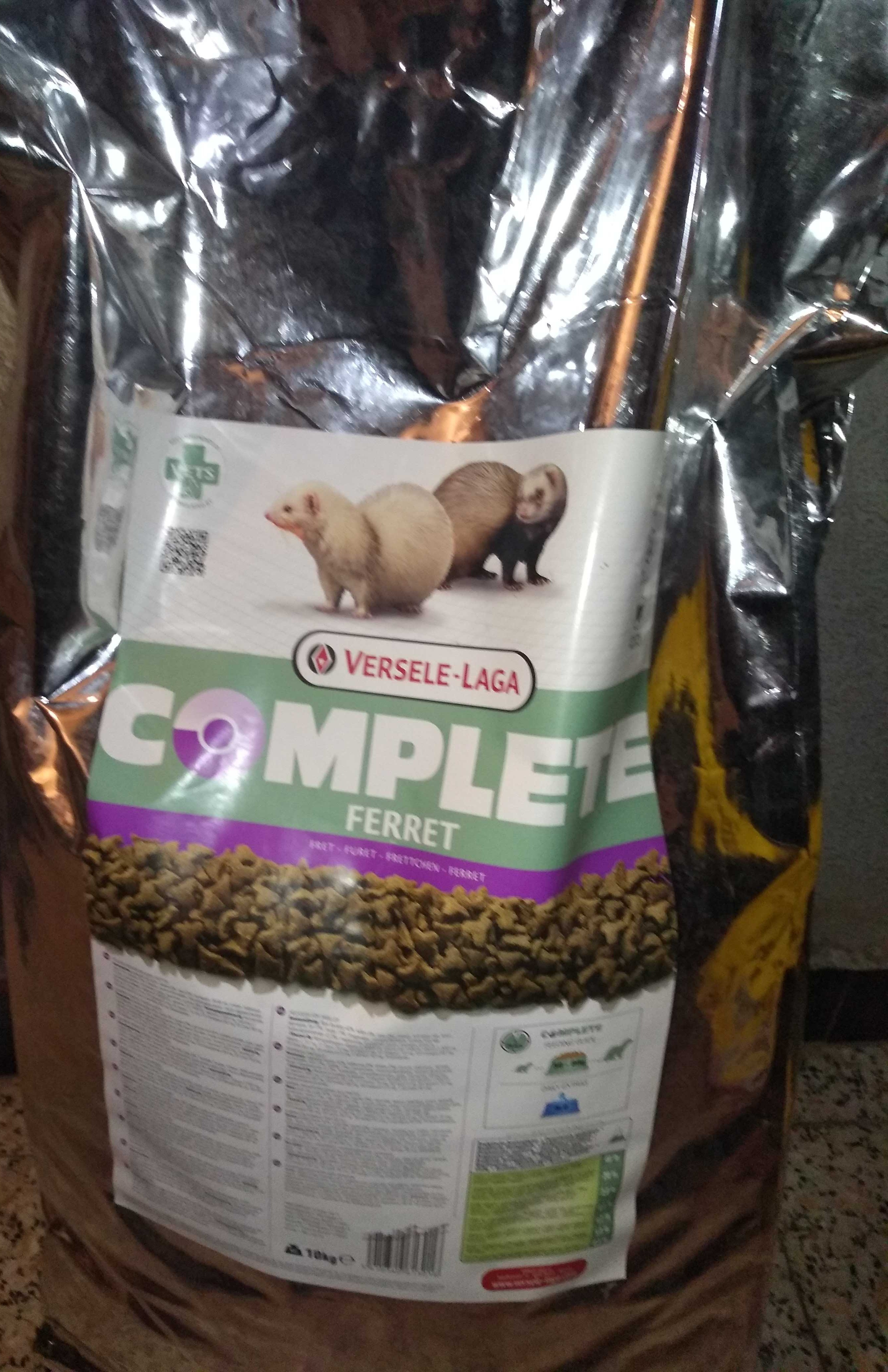
Dry food suited to the Standard
Origins & history
A story told
Representatives of the order Carnivora descend from miacids, mustelids separated from them during the Eocene, about 40 million years ago. The first representatives of the genus Mustela appear in the Miocene, about 20 million years ago and gradually give rise to ermines, minks, weasels and polecats. It is from the domestication of the latter that the ferret is born. In Europe, the domestication of the ferret, probably from the North African polecat, precedes the appearance of the cat by more than five centuries. The use of the ferret by man for hunting rodents and rabbits can be found as far back as the 4th century BC. The diffusion of the ferret throughout the rest of Europe was the work of the Romans. The Greeks and Romans used various mustelids for rat control and hunting, making it difficult to precisely distinguish the ferret in ancient writings. The nature of the Greek iktis is still subject to debate. In the 1st century BC, Strabo describes rabbit hunting in the Balearic Islands (Gymnesiae insulae), to combat massive proliferation of leporids the inhabitants ask the emperor Augustus for help. He sends them an animal specially trained for rabbit hunting, which is muzzled and put in rabbit burrows to make them come out. The procedure thus described corresponds exactly to the use of the ferret for hunting. From the 1st century, Columelle clearly distinguishes between the ferret and the polecat. Pliny the Elder, his contemporary, describes ferret hunting in the same way it was practiced in the 21st century. The ferret, like the ermine, remained a pet throughout the Middle Ages and the practice did not completely fall out of favor until the Romantic era. The famous painting Lady with an Ermine by Leonardo da Vinci, a portrait of Cecilia Gallerani, attests to this fashion. However, the enormous animal, whose size compared to the lady's hand can be estimated between 45 and 55 cm against 22 to 32 cm for an ermine, and whose front paws are not stocky enough, is clearly an albino ferret, even if Leonardo wished to represent the ermine, symbol of purity.
Character
Daily temperament
As with the dog, the domestication of the ferret led to the appearance of marked behavioral neoteny in this mustelid, in other words the ferret retains juvenile behavioral traits throughout its life. This domestication process has also developed its educational abilities thus facilitating cohabitation with its owners. Regarding its excretions, it makes its needs in a specific place like a cat. But unlike the latter ferret owners often resort to multiple litter boxes distributed in the home. Indeed, the pressing nature of the ferret's needs does not leave it time to make long trips to reach a single litter box. Unlike the dog, the ferret does not necessarily need outings. It is not possible to let a ferret go outside alone as it would eventually wander off and get lost, so a leash is mandatory. For the same reason, when the ferret owner has a garden and wants his animal to enjoy it freely, the garden must necessarily be enclosed and must not present any possibility of escape. Installing an electronic chip allows you to find the animal more easily if it is lost. It is mandatory if it travels within the European Union. The ferret poorly integrates punishment, education is thus mainly based on rewards, making it primarily an education by positive incentives. It is perfectly possible to teach various tricks to a ferret, however in accordance with the type of training required, the ferret will always act according to an expected reward and never to please its master as would be the case with a dog (hierarchical relationship). Pavlov's reflex plays an important part in ferret learning. Although being naturally crepuscular, the ferret can be trained to a diurnal lifestyle. The ferret is a social animal and needs to develop in a gregarious domestic environment. It can be raised with other ferrets or other carnivores like a cat or dog and will then have less need for its master to play. Play plays an important role in its activities. It is an animal that likes to attract the attention of its owners and its instinctive curiosity drives it to incite them to play and interfere in their activities. The ferret does not perceive itself in a hierarchical relationship like the dog, so its obedience is consequently more limited. The sleep of the ferret is a particularity among pets. Its master must thus adapt to this specific biological rhythm. The ferret sleeps approximately 12 to 18 hours per 24-hour period. When it sleeps, it enters a state of lethargy, and even if there is noise in its domestic environment, it does not wake up. Its body temperature drops from 39 ° C to about 37 ° C and its heart rate slows. Upon waking, the ferret must recover its activity temperature of 39 ° C, it trembles strongly to warm up, giving the impression of shivering. Although being of ancient domestication, the ferret retains certain primitive characteristics. From a behavioral point of view, the bite of the young ferret distinguishes it from most pets. It disappears around 4 to 6 months with education for 95% of ferrets but can sometimes persist into adulthood if the animal is poorly socialized or has not learned to control its bite. It is a fairly special case among domestic animals. Like other domesticated carnivores, the ferret is a playful animal. But due to its instinctive curiosity and grasping ability, domestic accidents with ferrets are much more frequent than with dogs or cats. This tendency has an impact on the bond with its owners which is more protective with a ferret than it would be with a dog or cat. Indeed, a ferret, even adult, asks to be supervised
Physical
Breed standard
Standard, musical composition of established popularity forming part of the "standard repertoire" of one or more musical genres. Jazz standard, musical composition that has particular importance in jazz. Blues standard, musical composition that has particular importance in blues.
Chapter 2
Daily life
What if you adopted your future companion?
The Standard of your dreams may already be waiting in a shelter. Hundreds of standard (and equally wonderful crossbreeds) are looking for a family in France — every adoption starts a new story.
Editorial recommendation — no affiliate links.
Âge
What human age for a standard ?
The calculator is already set to the breed's adult size (espérance de vie 6–10 ans). Drag the slider to see the equivalence and corresponding life stage.
Equivalent human age
36years
Adulte
Most stable period. Monthly weigh-in, annual vet visit, dental care — this determines quality of life in later years.
Estimate: Proportional estimate: a reference life expectancy of 8 years, scaled to an 80-year human life. No reference veterinary table exists for this species.
These equivalences are statistical benchmarks drawn from published veterinary tables. Every animal ages at its own pace, depending on genetics, diet and care. This calculator is neither a diagnosis nor veterinary advice.
Health
Health watch
Documented predispositions
insulinome — adjust diet and veterinary checks.
🐾 Products suited to this breedAlert
To avoid for ferret
Our database lists toxic ingredients and problematic additives by species.
- caffeineLow
- titanium dioxideHigh
- bitter almondHigh
- raisinsModerate
Calculator · daily ration
How much to give a standard ?
Estimate based on the veterinary formula RER × DER, adjusted for ferret. Adjust according to package recommendations.
Result
38 g
per day · 144 kcal
19 g / repas (2 par jour)
Calculation for food of 380 kcal/100g.
Maintenance
Daily care
Like all pets, the ferret is likely to be a vector of zoonoses. And this, both in the sense of anthropozoonosis (disease transmitted from humans to animals, such as human flu) and in the sense of zooanthroponosis (disease transmitted from animals to humans, such as rabies). Although a ferret is smaller than a dog or cat, it requires as much maintenance. It does not require daily outings unlike a dog, but it must be able to get out of its cage at least 2 to 4 hours a day. The ferret must be treated against internal and external parasites. A ferret kit must be wormed every month during its first 6 months then once adult twice a year (every 6 months), and must be regularly treated against parasites such as fleas or ticks. Usual antiparasitic treatments (dorsal drops) also protect the animal's ears. The ferret is sensitive to otitis caused by mites called "ear mange". As the ear sebum of the ferret is naturally brown, the usual diagnoses for dogs or cats are not applicable to the ferret. In case of suspected condition, the ears should be cleaned at two-week intervals using an antiparasitic topical agent (for ferrets or for kittens or otherwise for dogs by adjusting doses), or products adapted and prescribed by the veterinarian if the condition does not subside. The trimming of claws is usually carried out according to their wear and length. Wear depends on the terrain on which the ferret evolves. Bathing is not necessary for the ferret. On the contrary, too frequent baths or with unsuitable products damage the mustelid's skin and can cause excess sebum. A sandbox for it to roll in is more suitable. As with other domesticated carnivores, it is recommended to vaccinate the ferret against distemper, a still incurable fatal disease. Although this is virtually eradicated in France, it still appears sporadically. Only the C valence is necessary, in the absence of a vaccine with only C valence a vaccine with CH valences is generally used. Like any carnivore, the ferret can be contaminated by the rabies virus, moreover, rabies vaccination is mandatory in several countries and for crossing borders. It is required if the ferret circulates within the European Union. The ferret is particularly sensitive to vaccine-induced distemper in primary vaccination because of the use of dog vaccines (live attenuated virus or other types), only vaccines available in Europe.
Appears in
Standard in our rankings
Small ferret breeds
6 breeds ranked by size
See the rankingFerrets with the longest lifespans
Maximum documented lifespan — 10 years for the Standard
See the rankingThe most energetic ferrets
6 high-activity breeds
See the rankingThe best ferrets for apartment living
6 compact breeds suited to urban life
See the rankingFAQ
Frequently asked questions about Standard
How long does a Standard live?+
Can the Standard live in an apartment?+
Is the Standard suitable for children?+
If you like this ferret
Breeds with similar profiles

Champagne
Playful and hyperactive ferret.

Sable
Playful and hyperactive ferret.

Furet Standard
Playful and hyperactive ferret.

Furet Angora
Playful and hyperactive ferret.

Angora
Playful and hyperactive ferret.
For more information
Sources & official links
Supplementary documentation on reference sites — breed clubs, encyclopedias, veterinarians.
The right score for your Standard.
SokoScan calculates a personalized PawScore based on breed, age, weight and your pet's sensitivities. Free, instant.